
Why Eco-Friendly Plush Bags Are Safer for Children to Use?
Every year, millions of plush accessories enter children's daily lives — carried to school, hugged during naps, dragged across playgrounds and occasionally chewed by curious toddlers. Yet beneath the soft exterior of many plush bags lies a hidden question that too few parents and buyers ask: what exactly is in this product, and is it truly safe for a child to use every day? The answer increasingly points to one decisive factor — eco-friendly manufacturing. Understanding why eco-friendly plush bags are safer for children requires looking beyond surface-level softness and examining the materials, chemicals, production processes and certification standards that determine whether a plush accessory protects or endangers the child who uses it.
The global market is flooded with plush products that appear identical at first glance but differ dramatically in what they contain. Cheap fillers, untreated fabrics, untested dyes and poorly secured small parts can turn an adorable accessory into a source of skin irritation, respiratory discomfort or even choking risk. Eco-friendly plush bags address each of these vulnerabilities systematically, making them the responsible choice for parents, retailers and distributors who prioritize children's long-term well-being alongside aesthetic appeal.
The Hidden Risks Lurking in Conventional Plush Bags
Before exploring how eco-friendly materials solve safety problems, it is essential to understand the specific hazards that children face when using conventionally produced plush bags. These risks often go unnoticed because they do not cause immediate, visible harm — instead, they accumulate through daily contact over weeks and months.
Formaldehyde and Volatile Organic Compounds (VOCs)
Many low-cost plush fabrics undergo treatment with resins containing formaldehyde to achieve wrinkle resistance, color fastness or a smoother hand feel. When a child carries such a bag against their body for hours each day, formaldehyde can slowly release into the air they breathe and transfer to their skin. Prolonged exposure is linked to eye, nose and throat irritation, allergic reactions and, in high concentrations, more serious respiratory concerns. Eco-friendly production eliminates this risk by selecting fabrics that are processed without formaldehyde-based treatments.
Heavy Metals in Dyes and Pigments
Bright, attractive colors are a major selling point for children's plush bags, but some inexpensive dyes contain heavy metals such as lead, cadmium and arsenic. These substances can transfer from the fabric to a child's hands during normal handling, and from there to their mouth during eating or thumb-sucking. Eco-friendly plush bags use pigments that have been tested and certified free of heavy metals, ensuring that the vibrant colors children love do not come at the cost of their health.
Fluff Shedding and Inhalation Risk
Poorly anchored plush fibers can shed during use, creating tiny airborne particles that children may inhale. This is particularly concerning for children with asthma or allergies, as well as for toddlers who explore objects by putting them near their face. Eco-friendly plush bags use high-quality faux rabbit plush and short plush with strong fiber anchoring, minimizing shedding and maintaining a clean, fiber-free environment even after extended use.
Small Detachable Parts and Choking Hazard
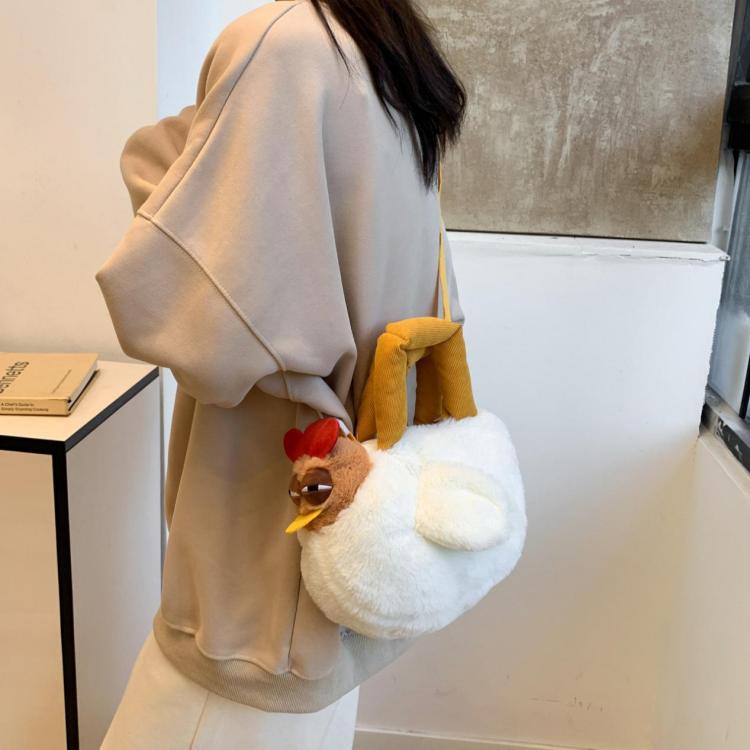
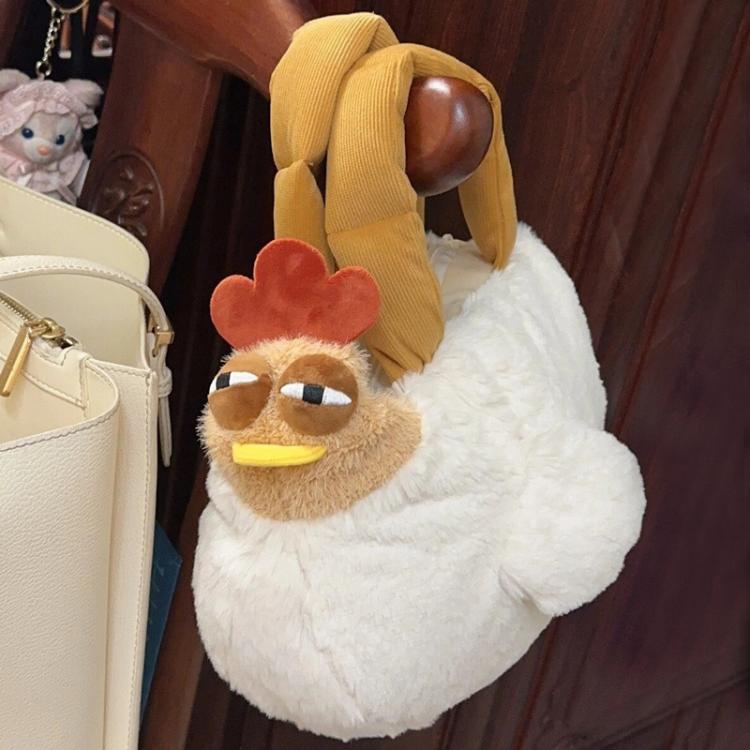
Plush bags often feature decorative elements — buttons, beads, sequins, plastic eyes and appliqués — that can detach if not securely fastened. For children under three, any small part that comes loose presents a serious choking risk. Eco-friendly manufacturers address this through rigorous tension testing on every attached component, ensuring that decorative elements withstand the pulling and twisting that children naturally apply. The Coo Chicken Plush Bag, for example, uses integrated 3D plush wings and embroidered facial features rather than glued-on plastic parts, eliminating detachment points entirely.
Skin Irritation from Harsh Chemical Residues
Children's skin is thinner and more permeable than adult skin, making it significantly more susceptible to irritation from chemical residues in fabrics and accessories. Conventional plush bags may retain residues from bleaching agents, dye fixatives or fabric softeners that cause redness, itching or rashes, particularly in children with sensitive skin or eczema. Eco-friendly materials are processed with milder, biodegradable chemicals and undergo thorough rinsing, leaving the fabric gentle enough for prolonged skin contact.
How Eco-Friendly Materials Layer Protection for Children
Safety in a plush bag is not achieved by a single material choice — it is the result of every component being selected and processed with child safety as the primary criterion. The Coo Chicken Plush Bag from YSD demonstrates how this layered approach works in practice.
Premium Faux Rabbit Plush and Short Plush Outer Layer
The main body of the Coo Chicken Plush Bag uses soft milky white faux rabbit plush, while the head features delicate brown short plush. Both materials are selected for their environmental testing results — free of formaldehyde and harmful substances, compliant with international toy safety standards. The dense fiber structure resists shedding, and the soft texture is gentle against children's skin. Unlike cheap plush that mattes and pills after minimal use, high-quality faux rabbit plush maintains its appearance and safety properties through repeated handling and cleaning.
Elastic 3D PP Cotton Filling
The filling material is often the most overlooked component in plush bag safety. Low-quality fillings may contain recycled fibers of unknown origin, chemical binders or even foreign objects. Elastic 3D PP cotton used in eco-friendly plush bags is a virgin, non-toxic filling that is hypoallergenic, resistant to bacterial growth and free of volatile compounds. It maintains its rounded, three-dimensional shape over time, ensuring that the bag does not develop lumps or thin spots that could expose internal components to a child's touch.
Safe Accessories: Corduroy Straps and Nylon Zippers
Every accessory on a child's plush bag must meet the same safety standards as the main fabric. The Coo Chicken Plush Bag uses ginger yellow corduroy hand straps and adjustable thick nylon shoulder straps — both materials are durable, non-toxic and free of harmful coatings. The hidden nylon zipper operates smoothly and quietly, eliminating the risk of pinched fingers that can occur with cheap metal zippers. The quiet operation also means the bag does not produce startling noises that could frighten young children during use.
Eco-Friendly vs. Conventional Plush Bags: A Safety Comparison
| Safety Dimension | Eco-Friendly Plush Bags | Conventional Low-Cost Plush Bags | Impact on Children |
| Fabric Chemicals | Formaldehyde-free, no harmful substances, environmental testing passed | May contain formaldehyde resins, VOCs and untested chemical treatments | Respiratory irritation, allergic reactions, long-term exposure risk |
| Dyes & Pigments | Heavy-metal-free, eco-friendly inks, color fastness tested | May contain lead, cadmium or arsenic in cheap dyes | Hand-to-mouth transfer, neurodevelopmental concerns with prolonged exposure |
| Fiber Shedding | Dense high-quality plush with strong anchoring, minimal shedding | Loose fibers that shed easily during handling | Inhalation risk, asthma and allergy triggers, eye irritation |
| Small Parts Security | Integrated/embroidered details, tension-tested components | Glued or weakly sewn decorative parts that may detach | Choking hazard for children under 3 years old |
| Filling Material | Virgin elastic 3D PP cotton, hypoallergenic, non-toxic | Unknown recycled fibers, possible chemical binders or contaminants | Skin irritation, bacterial growth, unpredictable allergen exposure |
| Zipper & Hardware | Smooth hidden nylon zipper, non-toxic corduroy and nylon straps | Cheap metal zippers that may pinch, coatings of unknown safety | Finger pinching risk, skin contact with potentially harmful coatings |
| Certification | CE (EN71), SGS, CPC, RoHS, REACH, ISO, DOC, Sedex 4P aligned | Often uncertified or with self-issued documents of questionable validity | No independent verification of safety claims |
International Safety Certifications: What They Actually Protect Against
Certification labels on a plush bag are not merely marketing decorations — each represents a specific set of tests and standards that independently verify a product's safety. Understanding what each certification covers helps buyers make informed decisions and gives parents confidence in the products they choose for their children.
CE Certification (EU EN71 Toy Safety Standards)
The CE mark indicates compliance with European Union toy safety directives, specifically the EN71 series of standards. EN71 covers mechanical and physical properties (including small parts detachment and tensile strength), flammability, and the migration of certain elements (heavy metals) from toy materials. For plush bags intended for children, CE certification means the product has been tested to ensure it does not present mechanical hazards, does not burn dangerously, and does not release harmful levels of heavy metals through normal contact or mouthing.
SGS Test Reports
SGS is one of the world's leading independent testing, inspection and certification companies. An SGS test report on a plush bag typically covers physical and mechanical testing, chemical analysis (including formaldehyde content, pH value, heavy metal content and azo dye detection), flammability testing and fiber composition verification. The independence of SGS testing ensures that safety claims are verified by a third party with no financial stake in the product's sale.
CPC (Children's Product Certificate)
Required for children's products sold in the United States market, a CPC certifies that the product complies with all applicable children's product safety rules enforced by the Consumer Product Safety Commission (CPSC). This includes compliance with the Consumer Product Safety Improvement Act (CPSIA) requirements for lead content, phthalate limits and testing by a CPSC-accepted laboratory. A CPC demonstrates that a plush bag meets the strict safety standards required for access to the U.S. children's product market.
RoHS and REACH Compliance
RoHS (Restriction of Hazardous Substances) limits the use of ten hazardous substances in electrical and electronic equipment, and its principles are increasingly applied to children's products as well. REACH (Registration, Evaluation, Authorization and Restriction of Chemicals) is a European Union regulation that addresses the production and use of chemical substances and their potential impacts on human health and the environment. For plush bags, REACH compliance means that all chemicals used in fabric processing, dyeing and finishing are registered and authorized, and that substances of very high concern (SVHCs) are not present above allowed limits.
ISO 9001 Quality Management and Sedex 4P Ethical Audit
While not product-specific safety certifications, ISO 9001 and Sedex 4P provide assurance that the manufacturing system itself operates to consistent, audited standards. ISO 9001 ensures that quality management processes are documented, followed and continuously improved — meaning that safety testing is not a one-time event but an integrated part of every production batch. Sedex 4P (SMETA ethical audit) covers labor standards, health and safety, environment and business ethics, ensuring that the safe products are also manufactured ethically and responsibly.
DOC (Declaration of Conformity)
A Declaration of Conformity is a legal document in which the manufacturer declares that the product meets all applicable EU safety, health and environmental protection requirements. It is a mandatory document for products bearing the CE mark and must be available to market surveillance authorities upon request. The DOC provides traceability and legal accountability, ensuring that someone is responsible for the safety claims made about the product.
Production-Level Quality Control: Where Safety Is Actually Built
Certifications verify the final product, but genuine safety is built into every stage of production. YSD's quality control system for plush bags operates as a continuous filter, catching potential safety issues before they reach the finished product stage.
Incoming Raw Material Screening
Every batch of fabric, filling, zipper, strap and decorative accessory undergoes environmental testing upon arrival at the factory. Formaldehyde content, pH value, color fastness and fiber composition are verified against specification sheets. Materials that fail testing are rejected before they enter production, ensuring that no unsafe raw material progresses to the cutting or sewing stage.
In-Process Inspection at Every Production Stage
Professional quality inspectors monitor each production procedure — from pattern cutting and piece sewing to filling, closure and finishing. Cutting precision ensures that fabric edges are clean and do not fray. Sewing inspection verifies that stitch density is consistent and that stress points (particularly strap attachments) are reinforced. Filling inspection confirms that 3D PP cotton is distributed evenly without lumps or thin spots.
Finished Product Safety Testing
Each completed Coo Chicken Plush Bag undergoes a battery of tests before shipment approval:
Fluff shedding test
Rubbing and shaking tests confirm that plush fibers do not shed at levels that could pose inhalation risk
Tension test
Every attached component (straps, zipper, decorative elements) is pulled with measured force to verify that it does not detach under conditions a child could realistically apply
Zipper smoothness test
Repeated opening and closing confirms that the hidden nylon zipper operates smoothly without catching, jamming or presenting pinch risks
Seam strength test
Pressure applied to the bag body verifies that seams do not split under the 1.5kg maximum load and beyond
Visual inspection
Each bag is examined for surface impurities, uneven plush, unsmooth lines and any defect that could affect safety or appearance
Traceable Production Records
Complete production files are retained for every batch, documenting raw material lot numbers, inspection results, testing data and shipment details. This traceability means that if a safety concern ever arises, the exact batch can be identified and investigated rapidly — protecting both children and the buyers who distribute the product.
YSD: A Manufacturer Built on Children's Safety
Baoding Yishengda Trading Co., Ltd (YSD) was founded in 1995 and has spent nearly three decades specializing in the design, development, production and global sales of plush toys and plush bags. Located in Baoding — a vital transportation hub connecting Beijing, Tianjin and Shijiazhuang — the company operates a 15,000㎡ factory with a 10,000㎡ construction area, equipped with complete production equipment and staffed by experienced R&D engineers.
YSD's approach to children's safety is not an afterthought or a marketing addition — it is embedded in the company's operational DNA. Every product, including the Coo Chicken Plush Bag, is designed with safety as a primary constraint from the earliest concept stage. Material selection, component design, production processes and testing protocols are all evaluated through the lens of "is this safe for a child to use every day?"
As an Alibaba Verified Gold plus supplier, YSD has passed official platform authoritative verification covering enterprise qualification, factory strength, production capacity and quality control system. This independent verification gives global buyers confidence that the factory behind the product is real, capable and committed to consistent quality.
What distinguishes YSD in the eco-friendly plush bag space
Nearly 30 Years of Plush-Specific Expertise
Three decades of focused experience in plush toy and bag manufacturing means that safety considerations are deeply institutionalized, not learned on each new product
Complete In-House Production Control
From raw material intake to finished product shipment, every step occurs within YSD's own facility, eliminating the quality variability that comes with outsourced production
Full Certification Portfolio
CE (EN71), SGS test reports, CPC, RoHS, REACH alignment, ISO 9001 quality management, DOC and Sedex 4P ethical audit provide comprehensive documentation for every major global market
Experienced R&D Engineering Team
In-house engineers develop products from customers' original designs, drafts and physical samples, ensuring that custom products meet the same safety standards as in-stock items
Transparent Factory Access
Real factory workshop photos and working scenes are available upon request, allowing buyers to verify production conditions and quality control processes firsthand
Global Export Track Record
Products exported to Europe, Southeast Asia and other regions with high repurchase rates, demonstrating that safety and quality standards meet or exceed international buyer expectations
Wholesale and Customization Options for Safety-Conscious Buyers
| Option | Description | Minimum Order | Safety Assurance |
| In-Stock Coo Chicken Plush Bag | Standard color scheme (milky white, brown, ginger yellow), 20cm×18cm×15cm, 1.5kg capacity, dual-carry design | 100 pcs | Pre-tested batch with CE, SGS and full export documentation |
| Custom Color Matching | Exclusive color palettes developed to match brand identity or regional market preferences | 500 pcs | All custom dyes undergo heavy-metal and azo-free testing before production approval |
| Custom Size Adjustment | Tailored dimensions for specific age groups or use cases, with proportional strap length adjustment | 500 pcs | Modified designs undergo full mechanical and safety testing before batch production |
| Logo Printing | Brand or event logo applied using eco-friendly, non-toxic printing methods | 500 pcs | Printing inks certified free of heavy metals and harmful compounds |
| Full ODM Development | Complete product development from customer concept, draft or physical sample by R&D engineers | 500 pcs | Prototype undergoes comprehensive safety review and testing before production begins |
Frequently Asked Questions
Q: What does "eco-friendly" actually mean for a plush bag?
A: For a children's plush bag, eco-friendly means that every material — outer fabric, filling, straps, zipper and dyes — has been selected and processed to minimize harm to both children and the environment. This includes formaldehyde-free fabric treatment, heavy-metal-free dyes, non-toxic virgin filling, biodegradable processing chemicals and packaging that minimizes waste. Eco-friendly products are also typically more durable, reducing the frequency of replacement and the overall environmental footprint.
Q: How do I know if a plush bag is truly safe rather than just marketed as safe?
A: Look for independent third-party certification rather than self-declared safety claims. Valid certifications include CE (with EU EN71 compliance), SGS test reports, CPC (for the U.S. market), RoHS and REACH compliance. Verify that the manufacturer can provide actual certificate documents with test results, not just a logo printed on packaging. YSD provides full sets of export qualification documents including CE certificates and SGS test reports for every product shipment.
Q: Are eco-friendly plush bags more expensive than conventional ones?
A: Eco-friendly plush bags may have a slightly higher unit cost due to the use of premium materials and the expense of independent testing and certification. However, the total cost of ownership is often lower because eco-friendly bags are more durable, retain their appearance longer and carry significantly lower risk of product recalls, returns or safety-related liability. For retailers and distributors, the assurance of certified safety also opens access to markets that uncertified products cannot enter.
Q: Can eco-friendly plush bags be washed without losing safety properties?
A: Yes, when following proper care instructions. High-quality faux rabbit plush and elastic 3D PP cotton maintain their structure and safety properties after gentle surface cleaning or hand washing. The key is to avoid harsh detergents, high-temperature drying and aggressive scrubbing that could damage fibers or affect printing. Eco-friendly materials are generally more resistant to degradation from cleaning than cheap alternatives.
Q: What is the age recommendation for the Coo Chicken Plush Bag?
A: The Coo Chicken Plush Bag is suitable for children aged 3 and above. It features integrated 3D plush wings and embroidered facial details rather than small detachable plastic parts, minimizing choking risk. However, as with all plush products, it is not suitable for children under 3 years old, and children should be kept away from small detachable accessories to avoid choking risk. Parental supervision is recommended for younger children.
Q: Do custom orders receive the same safety testing as in-stock products?
A: Absolutely. Every custom order — whether color matching, size adjustment, logo printing or full ODM development — undergoes the same rigorous safety testing as standard in-stock products. Custom dyes are tested for heavy metals and azo compounds, modified designs receive full mechanical and safety review, and every finished batch passes fluff shedding, tension, zipper smoothness and seam strength tests before shipment. Certification documentation is provided for all custom orders.
Final Thought
When a child places a plush bag over their shoulder each morning, carries it through a full day of school and play, and possibly hugs it at night, that product is in constant, intimate contact with a developing body. The materials it contains, the chemicals used in its production, the security of its components and the thoroughness of its testing are not abstract quality concerns — they are direct determinants of that child's health and safety.
Eco-friendly plush bags are safer for children because they address every layer of potential risk, from the molecular level of dye chemistry to the mechanical security of every stitched seam. They are backed by independent certifications that verify safety claims rather than relying on marketing language. They are produced in factories where quality control is not a final inspection step but an integrated process that begins before raw materials even enter the building.
For parents, choosing eco-friendly means choosing peace of mind. For retailers, distributors and gift suppliers, choosing eco-friendly means choosing products that protect children, reduce liability, open access to regulated global markets and build long-term trust with the families who buy them. YSD's nearly 30 years of plush manufacturing experience, 15,000㎡ standardized factory, comprehensive CE/SGS/CPC/RoHS/REACH/ISO/DOC/Sedex 4P certification support and flexible OEM & ODM capabilities make it a reliable partner for any buyer committed to putting children's safety first.
YSD Factory adheres to quality-oriented and integrity-driven operation, offering favorable factory direct prices and stable delivery schedules. The company welcomes large orders and custom requests, and is eager to establish long-term win-win partnerships with global buyers who share its commitment to children's safety.
For wholesale pricing, MOQ details, sample requests, certification documentation or custom scheme consultation for the Coo Chicken Plush Bag, contact the YSD sales team for professional one-stop service.